In today’s fast-paced digital world, texting and online chatting are part of everyday life. Short forms and abbreviations like igt are used to save time and keep conversations casual.
But not everyone knows what they mean. Understanding these terms is useful If you are texting friends, posting on social media, gaming, or even chatting professionally.
Misunderstanding them can lead to confusion or awkward situations. In this article, we will explore the meaning of igt, its origin, usage, and how to respond to it.
By the end, you will feel confident decoding and using this abbreviation in any digital conversation.
Definition & Meaning
IGT stands for I Guess That in texting and informal chats. It is commonly used to express uncertainty, hesitation, or a mild agreement.
Example in dialogue:
- A: Do you think we should go out tonight?
- B: Igt if everyone else is okay with it.
Here, igt shows that person B is not fully sure but is tentatively agreeing.
Sometimes, people use it interchangeably with I guess so or I suppose that, depending on the context. It can appear in texts, social media comments, gaming chats, and group messages.
Key point: Using igt conveys a casual and conversational tone, and it is not usually suitable for formal writing.
Background & History
The abbreviation igt emerged with the rise of text messaging and instant chat apps in the early 2000s. As people sought faster ways to type, shortcuts and acronyms became common. While there isn’t a single person or event that created it, its popularity grew among teenagers and young adults on platforms like SMS, AOL Instant Messenger, and later, Discord and WhatsApp.
Over time, igt evolved into a more flexible phrase. It is no longer just I guess that, but sometimes hints at uncertain or hesitant agreement. Unlike older acronyms like LOL or BRB, igt is less universally known, which makes it more niche and context-dependent.
Today, you’ll see igt mostly in informal texting, social media comments, and casual online discussions. Its usage is common among digital natives who prefer brief and efficient communication.
Usage in Various Contexts
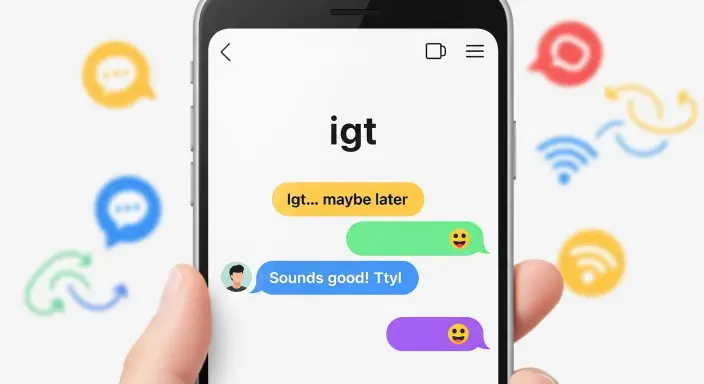
Texting with friends:
- A: Are you coming to the party?
- B: Igt, maybe later.
Social media comments:
- Igt, this trend is kinda cool.
Gaming chats:
- Do you want to try that new map?
- Igt let’s see if it’s fun.
Casual conversations:
- A: Do you think he’ll like the gift?
- B: Igt, hope so.
Key point: igt is versatile but informal. It works best when you want to show uncertainty, hesitance, or tentative agreement without committing fully.
Common Misconceptions & Clarifications
Some people confuse igt with other abbreviations like:
- IG (Instagram)
- IDK (I don’t know)
Misuse can cause confusion: for example, replying igt in a professional email may seem careless or lazy.
Clarification:
- Correct usage: casual conversations, texting, online comments
- Incorrect usage: formal emails, reports, or messages to
Similar Terms & Alternatives
Here’s a list of words similar to igt:
| Term | Meaning | Tone |
| I guess so | Mild agreement | Casual |
| I suppose | Tentative agreement | Neutral |
| Maybe | Uncertain | Casual |
| Kind of | Hesitant confirmation | Informal |
| Perhaps | Slightly formal uncertainty | Neutral |
Tip: Choose alternatives depending on your audience.
How to Respond to This Term
Casual:
- Cool, sounds good 😎
Funny: - Igt but only if there’s pizza 🍕
Professional: - Understood. Let me know the next steps.
Privacy-conscious: - Thanks, I’ll think about it.
Key point: Tone matters. Adjust your response according to the relationship and platform.
Regional or Cultural Differences
igt is primarily used in English-speaking digital spaces, especially the US, UK, and Canada. Non-English-speaking countries might not recognize it, or people may interpret it differently.
In some regions, users prefer local abbreviations or emojis to express uncertainty, e.g., in Japan, people might use 多分 (tabun – maybe) in texts.
Comparison with Similar Terms
| Term | Meaning | Usage context | Formality |
| Igt | I guess that | Casual chats | Informal |
| IDK | I don’t know | Casual chats | Informal |
| IMO | In my opinion | Online discussions | Semi-formal |
| TBD | To be determined | Planning/professional | Neutral |
Observation: igt is unique for its tone of hesitant agreement rather than uncertainty alone.
Usage in Online Communities & Dating Apps
On apps like Tinder or Twitter, igt helps maintain light, casual conversations without committing strongly.
Example on Tinder:
- Match: Do you like hiking?
- You: Igt sometimes, depends on the trail 😅
Tips:
- Use emojis to clarify tone
- Avoid overusing in professional or serious contexts
Hidden or Offensive Meanings
Currently, igt does not have offensive connotations. However, tone and context can change perception:
- If used dismissively, it might seem indifferent or rude
- Always pair with tone indicators like emojis or punctuation to clarify intent
Suitability for Professional Communication
Professional use: Not recommended.
Alternatives:
- I believe that
- It seems that
- Tentatively, I suggest
Key point: Save igt for informal texts or chats, not emails, reports, or meetings.
FAQs:
1. What does igt mean in texting?
- It stands for I guess that and expresses mild agreement or hesitation.
2. Is igt the same as IG?
- No, IG usually refers to Instagram.
3. Can I use igt professionally?
- No, it’s informal. Use I believe or tentatively instead.
4. Is igt offensive?
- No, but tone can affect how it’s perceived.
5. Where is igt most used?
- Texting, social media, gaming chats, and casual conversations.
6. Are there alternatives to igt?
- Yes: I guess so, maybe, I suppose, kind of.
7. How do I respond to igt?
- Casual, funny, professional, or neutral responses are all possible depending on context.
Conclusion:
igt is a small but versatile abbreviation that helps convey hesitation or mild agreement in digital conversations.
Understanding its meaning, context, and usage can make your online communication smoother and more relatable.
While it’s perfect for casual texting, it should be avoided in formal or professional settings.
Knowing alternatives and appropriate responses ensures you communicate clearly and politely.