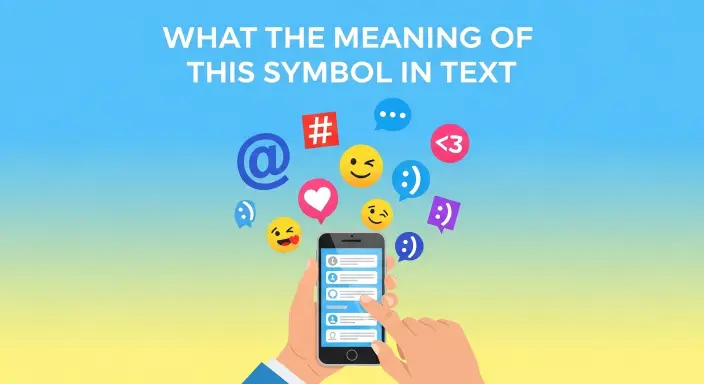
In today’s digital world, people use symbols in text messages, social media posts, and online chats to express emotions, ideas, or reactions quickly.
These symbols can be emojis, punctuation marks, or special characters that carry a meaning beyond their literal appearance. Sometimes a simple symbol like :), #, @, or <3 can change the tone of a message or make communication more expressive.
Many people see these symbols every day while texting friends, posting on social media, chatting in games, or even communicating at work. However, not everyone understands what these symbols actually mean or how they should be used.
Understanding the meaning of symbols in text is important because it helps avoid misunderstandings and confusion. It also allows people to communicate more effectively in digital conversations.
In this article, we will explore what symbols mean in text, how they are used, their history, and how to respond to them properly.
Definition & Meaning
A symbol in text is a character or sign used to represent an emotion, action, idea, or shorthand message in digital communication. These symbols help people express feelings quickly without writing long sentences.
For example:
- 🙂 means happiness or friendliness.
- 🙁 means sadness or disappointment.
- <3 represents love or affection.
- # is used to create hashtags on social media.
- @ is used to mention someone online.
These symbols are commonly used in text messages, social media platforms, online games, and chat applications.
Simple Example
Friend 1: I finally finished my exam 🙂
Friend 2: Nice! You must feel relieved.
Here, the 🙂 symbol shows happiness without needing to write I am happy.
Another Example
Friend 1: I missed the bus 🙁
Friend 2: Oh no, that’s frustrating.
The 🙁 symbol shows sadness or disappointment.
Symbols make messages shorter, clearer, and more emotional. They help replace facial expressions that we normally see in face-to-face conversations.
Background & History
Symbols in text started becoming popular in the early days of internet communication. When people began chatting online in the 1980s and 1990s, they needed a way to show emotions through plain text.
One of the earliest examples was the smiley emoticon 🙂, which was proposed in 1982 by computer scientist Scott Fahlman. It was used to show that a message was meant to be humorous.
Over time, these emoticons evolved into simpler versions, such as:
- 🙂
- 🙁
- 😀
- 😉
As technology improved, emojis were introduced in mobile phones and messaging apps. Emojis are graphic versions of these symbols and are now widely used on platforms like WhatsApp, Instagram, and Twitter.
Today, symbols are used not only for emotions but also for tags, mentions, reactions, and digital culture expressions.
Examples include:
- # (Hashtag) – used to categorize posts
- @ (Mention) – used to tag someone
- <3 (Heart) – used to show love
These symbols have become an important part of modern digital communication.
Usage in Various Contexts
Texting
People often use symbols to make messages friendlier or emotional.
Example:
Friend 1: Good luck for your interview!
Friend 2: Thank you! 🙂
Social Media
Symbols help organize and highlight posts.
Example:
Loving this weather! #SummerVibes
Gaming
Gamers use symbols to express reactions quickly.
Example:
Player 1: We won the match!
Player 2: GG 😀
Casual Conversations
Symbols make conversations feel less formal and more expressive.
Example:
Friend 1: Did you watch the movie?
Friend 2: Yes! It was amazing <3
Common Misconceptions & Clarifications
Some symbols can be misunderstood depending on context.
For example:
- 🙂 usually means happiness, but sometimes it can sound sarcastic.
- … (three dots) may suggest hesitation or awkwardness.
- 😉 can be seen as friendly or flirtatious.
Example:
Person 1: Sure… 🙂
This message might appear polite but could also hint at sarcasm depending on tone.
Another misunderstanding happens with hashtags. Many people think they are only decorative, but they actually help categorize content online.
Understanding context is important because the same symbol can carry different meanings.
Similar Terms & Alternatives
| Symbol | Meaning | Alternative |
| 🙂 | Happiness | 😊 |
| 🙁 | Sadness | 😢 |
| <3 | Love | ❤️ |
| 😉 | Wink | 😉 |
| 😀 | Big smile | 😄 |
These alternatives are often emoji versions of text symbols.
How to Respond to This Term
Casual Response
Friend: I finally passed my test 🙂
Response: That’s awesome!
Funny Response
Friend: I ate the whole pizza 😀
Response: Legend!
Professional Response
Colleague: Thanks for your help 🙂
Response: You’re welcome. Happy to help.
Privacy-Conscious Response
Friend: Miss you <3
Response: Hope you’re doing well.
Regional or Cultural Differences
Symbol usage is mostly universal, but some regions use different styles.
For example:
- Western users often write 🙂
- In Japan, people prefer (^_^) style emoticons.
Examples:
- (^_^) happy face
- (T_T) crying
- (-_-) annoyed
These styles show how culture influences digital expressions.
Comparison with Similar Terms
| Expression | Meaning | Context |
| 🙂 | Happy | Casual texting |
| 😀 | Very happy | Excited reaction |
| 😉 | Wink | Friendly or playful |
| <3 | Love | Romantic or friendly |
| 😂 | Laughing | Humor |
Each symbol expresses different emotional intensity.
Usage in Online Communities & Dating Apps
Symbols are heavily used on platforms like Twitter, Instagram, and dating apps.
For example:
Dating App Chat:
Person 1: Had a great time talking to you 🙂
Person 2: Me too!
Gamers also use quick symbols like:
- GG – Good Game
- 😀 – excitement
- 🙁 – frustration
Tips:
- Use symbols naturally.
- Avoid overusing them.
- Always consider the tone of the conversation.
Hidden or Offensive Meanings
Most symbols are harmless, but some may carry different meanings in certain communities.
For example:
- 😉 may appear flirtatious.
- <3 can suggest romantic feelings.
Tone and context matter because the same symbol can feel friendly or inappropriate depending on the conversation.
Suitability for Professional Communication
Symbols are usually not recommended in formal communication.
For example:
Informal message:
Thank you for your help 🙂
Professional alternative:
Thank you for your assistance.
However, in some relaxed workplaces, a simple smiley emoji may be acceptable.
FAQs:
1. What does a symbol mean in text?
It represents an emotion, idea, or action in digital communication.
2. Why do people use symbols in messages?
To express feelings quickly and make conversations more engaging.
3. Are text symbols the same as emojis?
No. Symbols are made using keyboard characters, while emojis are graphical icons.
4. Can symbols be misunderstood?
Yes, meaning can change depending on tone and context.
5. Are symbols appropriate in professional emails?
Usually no, unless the workplace culture is very casual.
6. What is the most common text symbol?
The smiley face 🙂 is one of the most widely used.
7. Do symbols mean the same thing worldwide?
Mostly yes, but some cultures use different emoticon styles.
Conclusion:
Symbols in text have become an essential part of modern digital communication. They help people express emotions, reactions, and ideas quickly in conversations.
From simple emoticons like 🙂 and 🙁 to symbols such as # and @, these characters make online messages more engaging and expressive.
Understanding the meaning of these symbols is important because it helps avoid confusion and improves communication.
While they are perfect for casual chats, social media, and gaming, they should be used carefully in professional settings.
By learning how symbols work and when to use them, anyone can communicate more clearly and effectively in the digital world.