
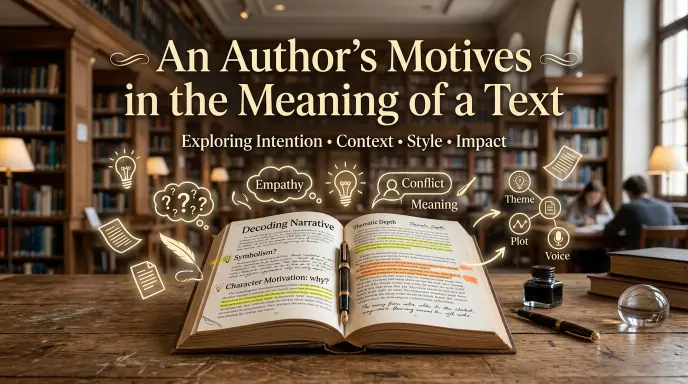
Understanding an author’s motives is an important part of reading and analyzing any text. Every writer has a purpose for creating a piece of writing, whether it is to inform, persuade, entertain, or express personal thoughts and feelings.
These motives often influence the words, tone, and ideas presented in the text. By identifying the author’s purpose, readers can gain a deeper understanding of the message being communicated.
Authors may use different techniques, examples, and language choices to achieve their goals and connect with their audience. Exploring an author’s motives helps readers look beyond the surface of the text and discover the meaning behind it.
This approach not only improves reading comprehension but also encourages critical thinking and a better appreciation of literature, articles, and other forms of written communication.
Definition & Meaning
An author’s motive refers to the purpose or intention behind creating a text. It explains why the writer chose to communicate a specific message, idea, or story.
Authors usually write for one or more of the following reasons:
- To inform
- To entertain
- To persuade
- To express feelings or opinions
- To inspire action
- To educate readers
The motive influences the language, tone, structure, and content of the text.
Example of an Informative Motive
A writer creates an article about healthy eating habits.
Reader: Why did the author write this?
Answer: To inform people about nutrition.
Example of a Persuasive Motive
A company publishes an advertisement promoting a product.
Reader: What is the author’s motive?
Answer: To persuade people to buy the product.
Example of an Entertainment Motive
A novelist writes a fantasy story.
Reader: Why was this text created?
Answer: To entertain readers.
Understanding motives helps readers move beyond the surface meaning and discover the author’s true purpose.
Background & History
The study of authorial motives has existed for centuries. Ancient philosophers and scholars examined why people wrote and how intentions affected meaning.
In ancient Greece, thinkers such as Aristotle discussed persuasion and communication. They believed writers used language to achieve specific goals.
During the Middle Ages, religious texts were often analyzed to understand the intentions of their authors. Scholars searched for hidden meanings and moral lessons.
In the modern era, literary criticism expanded the idea of authorial motives. Researchers studied how personal experiences, social conditions, and historical events influenced writing.
Over time, new theories emerged. Some critics argued that the author’s intention should guide interpretation. Others believed readers create meaning independently.
Today, understanding author motives remains an important part of education, literature studies, journalism, and media analysis. It helps readers evaluate information critically and understand communication more deeply.
Usage in Various Contexts
The concept of author motives appears in many forms of communication.
In Education
Students often analyze texts to determine why authors wrote them.
Teacher: What is the author’s purpose?
Student: The author wants to persuade readers to protect the environment.
In Social Media
Content creators often have clear motives.
User: Why did they post this?
Friend: Probably to raise awareness about the issue.
In Advertising
Businesses create content to influence customer decisions.
Customer: This ad seems convincing.
Friend: That’s because the author’s motive is persuasion.
In Journalism
News articles may aim to inform, explain, or influence public opinion.
In Literature
Novelists use stories to entertain while also exploring themes and ideas.
In Gaming
Game narratives often include messages about teamwork, survival, or personal growth.
Recognizing motives helps people understand content across different platforms and situations.
Common Misconceptions & Clarifications
Many people misunderstand author motives.
Misconception 1: Every Author Has Only One Motive
This is not always true.
A writer may want to inform and persuade at the same time.
Misconception 2: The Motive Is Always Obvious
Some motives are hidden beneath the surface.
For example, a story may entertain while also criticizing society.
Misconception 3: Readers Always Agree on the Motive
Different readers can interpret the same text differently.
Misconception 4: Motives Never Change
Authors may revise their work or communicate different messages to different audiences.
Clarification
The best way to identify motives is to examine:
- Tone
- Word choice
- Audience
- Context
- Main message
Looking at these factors provides stronger evidence than relying on assumptions.
Similar Terms & Alternatives
Several terms are closely related to author motives.
| Term | Meaning |
| Author’s Purpose | The reason for writing |
| Intention | The planned goal behind the text |
| Objective | The desired outcome |
| Message | The idea being communicated |
| Theme | The central concept explored |
| Point of View | The author’s perspective |
Key Difference
An author’s motive focuses on why the text was written, while a theme focuses on what idea is explored.
How to Respond to This Concept
When discussing author motives, responses can vary depending on the situation.
Casual Response
I think the author wrote this to entertain readers.
Analytical Response
The text uses emotional language, suggesting the author aims to persuade the audience.
Professional Response
The author’s motive appears to be educational, based on the factual information presented.
Critical Response
The author’s purpose may influence how information is presented, so readers should evaluate the evidence carefully.
Classroom Response Example
Teacher: Why did the author write this article?
Student: The author wanted to inform readers about climate change.
Regional or Cultural Differences
The concept of author motives exists across cultures and languages.
Different societies may place varying importance on understanding author intentions.
Western Literary Traditions
Many educational systems emphasize analyzing author purpose and intention.
Eastern Literary Traditions
Some approaches focus more on the text itself and its broader cultural meaning.
Modern Global Communication
The internet has made content available worldwide, allowing people from different cultures to interpret motives differently.
Language Differences
While terminology changes between languages, the basic idea remains the same: understanding why a writer communicates a message.
Comparison with Similar Terms
| Term | Focus | Main Question |
| Author’s Motive | Reason for writing | Why was it written? |
| Theme | Central idea | What is the text about? |
| Tone | Attitude | How does the author feel? |
| Audience | Intended readers | Who is it for? |
| Message | Key lesson | What should readers learn? |
| Perspective | Viewpoint | From whose angle is it written? |
Understanding all these elements provides a fuller interpretation of a text.
Usage in Online Communities & Dating Apps
Online platforms frequently involve analyzing motives.
Social Media
Users often question why content was posted.
User A: Why did they share this?
User B: They probably want attention or awareness.
Dating Apps
People may interpret motives behind messages and profiles.
Person A: Why did they write that bio?
Person B: Maybe they want to appear friendly and approachable.
Gaming Communities
Players analyze developer notes, updates, and announcements.
Discussion Forums
Users often debate the intentions behind articles, videos, and comments.
Helpful Tip
Before assuming a motive, consider context and available evidence.
Hidden or Offensive Meanings
The phrase an author’s motives in the meaning of a text is not offensive.
However, motives can sometimes involve controversial messages.
Why Context Matters
The same text can be interpreted differently depending on:
- Audience
- Culture
- Historical period
- Personal experiences
Potential Risks
Readers may incorrectly assume motives without sufficient evidence.
This can lead to misunderstandings.
Best Practice
Base conclusions on textual evidence rather than personal assumptions.
Suitability for Professional Communication
The concept is highly appropriate in professional and academic settings.
It is commonly used in:
- Education
- Journalism
- Research
- Literature studies
- Communication analysis
Professional Example
The author’s motive appears to be informing stakeholders about recent policy changes.
Academic Example
Analyzing author motives provides insight into the text’s intended impact.
Professional Alternatives
- Author’s purpose
- Intended message
- Communication objective
- Writing intention
- Content goal
These alternatives are often used in reports, presentations, and academic discussions.
FAQs:
1. What are an author’s motives?
An author’s motives are the reasons or purposes behind creating a text.
2. Why is understanding author motives important?
It helps readers interpret meaning more accurately and think critically.
3. Can a text have multiple motives?
Yes. Many texts inform, persuade, and entertain at the same time.
4. How can I identify an author’s motive?
Look at the tone, audience, language, and overall message.
5. Are author motives always obvious?
No. Some motives are direct, while others are subtle or hidden.
6. Do readers always agree on author motives?
No. Different interpretations are common.
7. Is author motive the same as theme?
No. Motive explains why the text was written, while theme explains the central idea.
Conclusion:
Understanding an author’s motives in the meaning of a text is an essential reading skill. It helps readers move beyond the words on the page and discover the purpose behind the message. Authors write to inform, persuade, entertain, educate, or express personal ideas.
By examining tone, audience, context, and language, readers can better understand these intentions.
This concept is valuable in literature, education, journalism, social media, online communities, and professional communication. It also encourages critical thinking by helping people evaluate information more carefully.
While motives are not always easy to identify, analyzing them provides deeper insight into how texts communicate meaning. If reading a novel, news article, advertisement, or online post, recognizing the author’s motives can lead to a richer and more informed understanding of the content.

I am Jonathan Parker, creator of Texttak.com, where simple words create real impact. I focus on clear, trendy, and engaging content that connects with today’s audience.