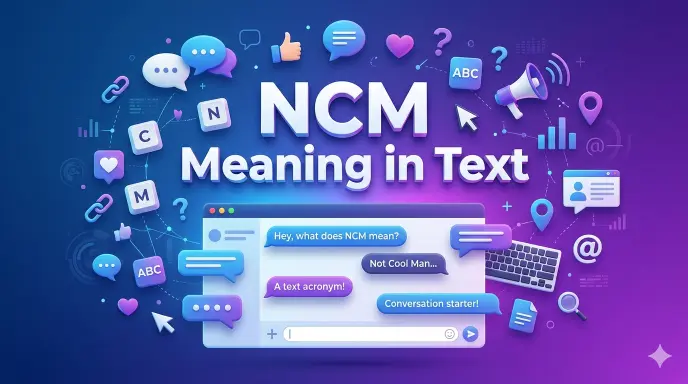
In today’s fast-paced digital world, people often use short forms and abbreviations to make texting quicker and easier. One abbreviation that may appear in messages, social media posts, or online chats is NCM. If you have received this term and are unsure what it means, you are not alone.
The meaning of NCM in text can vary depending on the conversation and the context in which it is used. In many cases, it is used as a shorthand expression to save time while communicating online.
Understanding texting abbreviations like NCM can help you avoid confusion and improve your online communication. If you are chatting with friends, reading comments on social media, or participating in online communities, knowing the meaning behind common acronyms makes conversations easier to follow.
In this article, we will explore the different meanings of NCM, how it is used in text messages, and examples that will help you understand it better.
Definition & Meaning of NCM
NCM is an abbreviation that can have different meanings depending on the context in which it is used. In text messaging and online communication, users often create shorthand expressions to make conversations faster and more convenient.
One common interpretation of NCM is No Comment Made. People use it when they do not want to add further information to a discussion. In some communities, NCM may also stand for other phrases related to a specific industry, group, or online platform.
The exact meaning often depends on who is using it and where it appears.
Example Usage
Friend 1: What do you think about the argument yesterday?
Friend 2: NCM.
In this case, the person is choosing not to comment on the situation.
Another Example
User A: Did you see the latest update?
User B: NCM for now.
Here, the user prefers not to share an opinion at the moment.
Because abbreviations can have multiple meanings, it is always helpful to consider the surrounding conversation before assuming a specific definition.
Background & History
The rise of internet slang began with chat rooms, SMS messaging, and early social networking platforms. Users looked for ways to communicate faster while dealing with character limits and slower typing methods.
Abbreviations such as LOL, BRB, IMO, and NCM became popular because they reduced typing effort. While NCM is not as widely recognized as some internet acronyms, it follows the same pattern of shortening longer phrases into a few letters.
As texting culture evolved, different online communities started creating their own meanings for abbreviations. This is one reason why NCM can represent different phrases depending on the group using it.
Today, abbreviations remain common on messaging apps, gaming platforms, forums, and social media sites. NCM continues to be used in niche communities and specific conversations where participants understand its intended meaning.
The flexibility of internet language means that new meanings can emerge over time, making context increasingly important.
Usage in Various Contexts
NCM may appear in several different digital environments.
Text Messaging
People use NCM when they prefer not to provide an opinion.
Person A: Do you agree with the decision?
Person B: NCM.
Social Media
Users may reply with NCM when avoiding controversial discussions.
Comment: What’s your opinion on this topic?
Reply: NCM.
Gaming Communities
Gamers sometimes use abbreviations to keep messages short during gameplay.
Player 1: Who caused the loss?
Player 2: NCM.
Online Forums
Forum members may use NCM when they do not want to participate in a debate.
User A: Can you explain your position?
User B: NCM at this time.
The meaning remains similar across these contexts: choosing not to comment or provide additional information.
Common Misconceptions & Clarifications
One common misunderstanding is assuming that NCM always has one universal meaning. In reality, many internet abbreviations change depending on the platform or community.
Some users may believe NCM is a negative response. However, it is often neutral and simply indicates that someone does not wish to share an opinion.
Another misconception is that NCM is rude. While it can appear blunt, tone and context matter. A friendly conversation may interpret it differently than a heated debate.
Important Clarifications
- NCM does not always mean the same thing.
- Context determines the correct interpretation.
- It is usually not considered offensive.
- It often indicates neutrality rather than disagreement.
When uncertain, asking for clarification is the safest approach.
Similar Terms & Alternatives
Several abbreviations convey a similar idea to NCM.
| Term | Meaning | Usage |
| NCM | No Comment Made | Declining to comment |
| NC | No Comment | Refusing to give an opinion |
| IDC | I Don’t Care | Showing lack of interest |
| IMO | In My Opinion | Sharing a personal view |
| N/A | Not Applicable | Information not relevant |
These alternatives may be used depending on the situation and desired tone.
How to Respond to This Term
The best response depends on the conversation.
Casual Response
Okay, no problem.
Friendly Response
Got it, maybe later.
Funny Response
Keeping secrets today?
Professional Response
Understood. Thank you for your response.
Privacy-Conscious Response
I respect your decision not to comment.
These responses help keep the conversation respectful and comfortable.
Regional or Cultural Differences
NCM is primarily associated with English-language online communication. However, internet slang often spreads internationally through social media and gaming platforms.
Different countries may use local abbreviations that serve a similar purpose. While NCM may not be universally recognized, the concept of declining to comment exists in many languages.
Younger internet users are generally more familiar with such abbreviations than older generations.
Cultural differences can also influence how people perceive brief responses. Some cultures view short replies as efficient, while others may consider them abrupt.
Comparison with Similar Terms
| Expression | Meaning | Tone |
| NCM | No Comment Made | Neutral |
| NC | No Comment | Neutral |
| IDC | I Don’t Care | Casual |
| Pass | Prefer not to answer | Friendly |
| No Opinion | No viewpoint available | Formal |
Although these phrases are similar, each carries a slightly different tone and purpose.
Usage in Online Communities & Dating Apps
NCM occasionally appears in online communities where users discuss sensitive or controversial topics.
On Social Media
People may use NCM to avoid arguments.
On Gaming Platforms
Players may avoid discussing team conflicts by replying with NCM.
On Dating Apps
Someone might use NCM when they are uncomfortable answering a personal question.
Tips for Responding
- Respect personal boundaries.
- Avoid pressuring someone for details.
- Continue the conversation politely.
- Focus on other topics if necessary.
Respectful communication creates a better online experience for everyone.
Hidden or Offensive Meanings
Generally, NCM is not considered offensive. However, like many abbreviations, alternative meanings may exist in specific communities.
The phrase itself is usually neutral. Problems arise when people interpret the tone incorrectly.
For example, a simple NCM response might appear dismissive in a serious discussion. In another conversation, it may simply mean the person prefers not to share an opinion.
Why Context Matters
- Tone changes meaning.
- Different communities use different definitions.
- The same abbreviation can have multiple interpretations.
Always consider the conversation before drawing conclusions.
Suitability for Professional Communication
NCM is usually best suited for casual conversations rather than professional communication.
In business settings, clear language is often preferred.
Better Professional Alternatives
- No comment at this time.
- I do not have information to share currently.
- I prefer not to comment.
- I am unable to provide feedback at this moment.
These alternatives sound more professional and reduce the risk of misunderstanding.
FAQs:
What does NCM mean in text?
NCM commonly means No Comment Made, though meanings may vary by context.
Is NCM rude?
Not usually. It is generally a neutral way of declining to comment.
Is NCM commonly used?
It is less common than abbreviations like LOL or BRB but still appears in some online communities.
Can NCM have different meanings?
Yes. Different groups and industries may use NCM differently.
How should I respond to NCM?
A polite response such as Okay or Understood usually works well.
Is NCM appropriate for work emails?
It is better to use full professional phrases instead of abbreviations.
Does NCM have offensive meanings?
Generally no, but meanings can vary by community and context.
Conclusion:
NCM is a texting abbreviation that commonly means No Comment Made or a similar expression indicating that someone prefers not to share an opinion. Like many internet acronyms, its exact meaning depends on the conversation and the community using it.
You may encounter NCM in text messages, social media discussions, gaming chats, online forums, and occasionally on dating apps.
Understanding NCM helps prevent confusion and allows you to respond appropriately. While the abbreviation is generally neutral and not offensive, context plays an important role in determining its intended meaning.
In casual conversations, a simple acknowledgment is often the best response. In professional settings, however, using complete phrases is usually more effective.
As online language continues to evolve, abbreviations like NCM remain useful tools for quick communication. Knowing their meanings can help you navigate digital conversations with greater confidence and clarity.

Hi, I’m Nathaniel Carter your go-to source for fresh, trending, and unique text content. At TextTak.com, I curate ideas, inspiration, and engaging snippets that keep you ahead of the curve. If it’s witty messages, viral phrases, or creative text hacks, I make sure your words always stand out. Join me on this journey to make every message unforgettable.